

Understanding the Mealworm Lifecycle for Successful Farming
Open a mealworm tray at the wrong moment and it can look as though the colony has vanished. The eggs are almost impossible to spot, newly hatched larvae disappear into the substrate, and pupae stay so still that they are often mistaken for dead insects. Then an adult beetle appears, looking nothing like the mealworm that went into the tray.
It is all one species. The yellow mealworm, Tenebrio molitor, develops through four stages: egg, larva, pupa, and adult darkling beetle. “Mealworm” is the name used for the larval stage, not the final form of the insect.
Quick answer: A complete mealworm life cycle can take about four months under favorable rearing conditions, but it may take considerably longer. University of Maine Cooperative Extension notes that the egg-to-egg cycle often lasts more than a year outside ideal conditions. Temperature, food, moisture, density, and the age of the insects all affect the timing. (1)
Mealworm Life Cycle at a Glance
The ranges below are useful for planning a home colony, but they are not deadlines. One research review reports that eggs may hatch in 3 to 9 days under controlled conditions, while Extension guidance gives roughly 18 days. The larval stage can stretch much further when the colony is cool or conditions are less favorable. (1) (5)
| Stage | What is happening | Useful home-rearing estimate | What you may notice |
|---|---|---|---|
| Egg | The embryo develops inside a tiny, pale egg hidden among the substrate | Several days to about 3 weeks to hatch; allow 1 to 4 weeks before larvae are easy to notice | The tray may appear empty |
| Larva | The mealworm feeds, grows, and molts repeatedly | Around 8 to 10 weeks in a fast, warm colony; several months in slower conditions | Active larvae, shed skins, and increasingly fine substrate |
| Pupa | The body reorganizes into the adult form without feeding | Often 1 to 3 weeks, with wider ranges reported at different temperatures | A pale, curled body with very little movement |
| Adult beetle | The beetle feeds, mates, and lays the eggs that begin the next generation | Reproduction may begin within days to about 2 weeks; adults can remain alive for several months | New adults begin pale, then turn brown and finally black |

What Do Mealworms Turn Into?
Mealworms turn into adult darkling beetles. More precisely, the yellow mealworm is the larva of Tenebrio molitor, a species in the darkling beetle family. The change from larva to beetle passes through a distinct pupal stage.
This type of development is called complete metamorphosis. The egg, larva, pupa, and adult do not simply look like larger versions of one another; each stage has a different job. Larvae concentrate on feeding and growth. Pupae stop feeding while the adult body forms. Adult beetles keep the colony going by reproducing.
For an animal keeper, the larva is usually the main feeder stage. In a self-replenishing colony, however, the adult beetle is hardly disposable. Every future tray of mealworms depends on keeping a working breeder population.
Dogs and cats have different feeding needs, so home-raised insects should not be treated as an automatic replacement for natural treats and chews for pets.
Stage 1: Egg
Mealworm eggs are tiny, pale, slightly sticky, and easily coated with dust or substrate. Even when a tray contains many eggs, it can look completely inactive. That is why an apparently empty breeding tray should be dated and left undisturbed long enough for hatchlings to grow into something you can actually see.
Female output varies more than a single number suggests. Home-rearing guides commonly cite roughly 100 to 500 eggs per female, while University of Maine Cooperative Extension reports that a female can lay up to 1,000. Adult age, density, food, oviposition time, and the breeding setup all influence how many eggs are produced and how many survive. (1) (3)
In a perforated beetle tray, the eggs fall or are laid through the openings into the pod below. This separates them from most of the adults, which matters because beetle density and egg cannibalism can reduce the number of larvae that eventually emerge. (3)
The egg may hatch before you notice any movement. Under warm, controlled conditions, published hatching times can be less than two weeks; cooler or less consistent home conditions may take longer. The original 1-to-4-week estimate remains useful when it is understood as the practical wait for visible larvae, not a guaranteed incubation period.
Stage 2: Larva
This is the familiar mealworm stage. Larvae burrow through the food substrate, eat, grow, and shed their exoskeleton several times. A newly molted larva appears pale and soft, then darkens as the new outer layer hardens. The number of molts is not fixed; scientific literature reports substantial variation with rearing conditions. (5)
The often-quoted 8-to-10-week larval period describes a fairly quick colony. It should not be treated as a countdown clock. University of Maine describes six to nine months for newly hatched larvae to mature in less optimized conditions, which helps explain why two keepers can start in the same month and see pupae at very different times. (1)
As larvae feed, the tray accumulates droppings, uneaten feed particles, and shed exoskeleton. This material is commonly called frass in mealworm farming. It contains plant nutrients and chitin-rich material, and researchers are studying its use as a soil amendment and its possible effects on plant defense. Its composition depends on the insects' feed and rearing conditions, so it should not be described as a complete fertilizer for every plant. (6) Our frass fertilizer comparison looks at that use in more detail.
A new colony needs future breeders before it can support regular harvesting. Letting most or all of the first mature group pupate can build that breeder population faster. Once several generations are moving through the system, harvest the larger active larvae while deliberately reserving enough to pupate. “As many as you like” only works if the number left behind is large enough to keep the cycle running.
Stage 3: Pupa
A mature larva stops feeding, curls into a C shape, and becomes a pupa. It does not build a cocoon. Fresh pupae are creamy white and soft; they gradually develop darker yellow or brown areas as the adult beetle forms inside.
Pupae may twitch when gently disturbed, but some show almost no visible movement. Lack of a wriggle by itself does not prove that the pupa is dead. Look instead for collapse, an unusual smell, mold, or extensive dark decay, and avoid repeatedly picking up healthy pupae simply to test them.
In a mixed container, pupae are exposed to active larvae and adult beetles that can damage or consume them. Moving each new pupa to a protected platform or separate pupal area improves the chance that it will reach adulthood. Purpose-built mealworm growing kits organize this separation; a DIY colony requires the same job to be done by hand. (4)
The pupal stage often lasts roughly one to three weeks in a home colony. Research reports a wider temperature-dependent range, so a pupa that does not produce a beetle on the expected day is not automatically a failed one. (5)
Stage 4: Adult Darkling Beetle
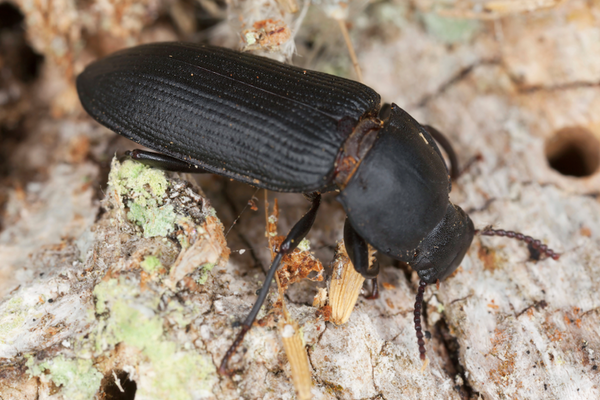
The adult beetle emerges from the pupa with a pale, soft outer body. Over the next few days, it hardens and changes from cream to brown, then to the dark brown or black associated with a mature yellow mealworm beetle.
Adult beetles feed and need controlled moisture just as the larvae do. They also mate and lay eggs. Under one controlled set of rearing conditions, females became fertile within a few days of emergence, although home colonies may not produce visible offspring for several weeks. The beetles' age and density influence egg yield, which is one reason a crowded breeding tray can perform worse than expected. (3)
Adult lifespan varies with temperature, food, density, and the source population. Several months is a realistic expectation, while longer lifespans are also reported. Remove dead beetles during routine checks, but do not wait for the whole adult group to die before moving the breeding tray. Rotating living adults gives the eggs and tiny larvae in the previous pod time to develop with less disturbance.
How Long Is the Mealworm Life Cycle?
If you start with an egg and wait for the resulting adult to lay the next eggs, the complete cycle can finish in about four months under favorable conditions. In a cooler room or a colony with limited food, inconsistent moisture, or slower-growing insects, it may take far longer. University of Maine reports that an egg-to-egg cycle commonly extends beyond a year outside ideal conditions. (1)
That full-cycle answer is different from “How long until my mealworm becomes a beetle?” A mature larva may pupate soon after arrival, then emerge as a beetle within a few weeks. A tiny newly hatched larva still has its entire feeding and molting period ahead of it. When starter insects are sold only by count or weight, their age range can make the first tray look unpredictably fast or slow.
This is also why the calendar alone cannot tell you when to harvest. Large, active larvae are the feeding stage most keepers want. Once a larva stops feeding and curls toward pupation, it has already moved beyond that harvest window.
What Changes Mealworm Growth and Development?
Temperature
Temperature strongly affects larval survival, growth, and development time. In a controlled study comparing 20°C, 25°C, and 30°C, the shortest development and strongest growth occurred at 25°C and 30°C under constant darkness. That result does not make 30°C a universal home target. Trays develop hot spots, direct sunlight can raise the substrate above room temperature, and the best range may differ by stage and setup. (2)
For a home colony, steady conditions around 21 to 27°C (70 to 80°F) are a practical working range. The original 25-to-28°C guidance describes the warmer end often used to encourage faster development. Measure the temperature at tray level, follow the instructions supplied with the insects or kit, and do not assume that raising it further will keep shortening the cycle.
Food and moisture
Larvae and beetles need a dry food substrate plus a controlled moisture source. Clean wheat bran or oats are common home-colony feeds, while small pieces of firm produce can provide moisture. Diet composition affects growth, survival, and reproduction, but an “organic” label alone does not guarantee larger mealworms or faster development. Our mealworm feeding guide covers everyday feed and moisture choices.
Too much wet food can create mold, mites, or compacted substrate. Too little moisture may slow the colony. Add produce in portions the insects can use before it spoils, keep it on the surface, and never pour water into the bedding.
Density, stage separation, and starting age
Overcrowding changes access to food and can reduce reproductive efficiency. Mixing every stage in one container also exposes eggs and pupae to more disturbance and cannibalism. Finally, a shipment of mature larvae will reach pupation sooner than a tray of young larvae even when both are kept under identical conditions. Dated labels are more useful than guessing from size alone.
Using the Life Cycle in a Mealworm Farm
Knowing the biology is useful because each visible change asks for a different action. It tells you when to protect pupae, when to rotate the beetle tray, and which larvae can be harvested without ending the colony.
- Begin with larvae, beetles, or both. Starting with mealworms is straightforward because they are easy to handle. A mealworm and beetle starter pack shortens the wait by introducing two stages at once.
- Let the first breeder group mature. A new colony needs enough pupae and adults before repeated harvesting becomes sustainable.
- Move pupae to the protected platform. Transfer them gently as they appear rather than leaving them among active larvae.
- Feed the adult beetles and date the breeding pod. Eggs fall into the substrate below and remain difficult to see even after hatching.
- Rotate the beetle tray before generations become mixed. Bug Factory's kit setup guide moves the beetle tray to the next pod after about a month. Follow the timing for your own system rather than disturbing the previous substrate to search for eggs.
- Harvest mature larvae while preserving replacements. Take large, active mealworms before pupation and keep a planned share for the next breeder group.
This article explains what changes inside the cycle. For container setup, ventilation, maintenance, stage separation, and troubleshooting, use our complete guide to raising mealworms at home.
Frequently Asked Questions
Do mealworms turn into beetles?
Yes. A mealworm is the larval stage of the yellow mealworm beetle, Tenebrio molitor. It first becomes a pupa, then an adult darkling beetle emerges.
How long does it take a mealworm to turn into a beetle?
A young larva may need several months to finish growing, while a mature larva can pupate much sooner. After pupation, the adult commonly emerges in about one to three weeks. Temperature, diet, moisture, and the starting age of the larva change the total wait.
How long do mealworms stay in the pupa stage?
One to three weeks is a useful home-rearing estimate. Published research reports a wider range under different temperatures, so judge the pupa's condition as well as the date.
How many eggs does a mealworm beetle lay?
A female can lay hundreds of eggs during her adult life. Home guides frequently cite 100 to 500, while University of Maine Extension reports up to 1,000. Adult age, density, food, and the breeding system influence the result.
How long do mealworm beetles live?
Adult yellow mealworm beetles often live for several months, although longer lifespans are reported. Temperature, food, density, and other colony conditions all affect longevity.
Why can I not see mealworm eggs or new larvae?
The eggs are extremely small and collect dust or substrate on their sticky surface. Newly hatched larvae are also tiny and tend to burrow. Label the pod and give it time before deciding that the breeding cycle failed.
Are giant mealworms and superworms the same species?
No. This guide covers the yellow mealworm, Tenebrio molitor. Superworms or giant mealworms are commonly Zophobas morio, and their development and pupation requirements should not be copied from this lifecycle.
Plan for Stages, Not Exact Dates
A stable mealworm colony does not move in perfect weekly batches. One tray may contain nearly invisible larvae while another produces pupae every day. The job is to respond to the stage in front of you: feed active larvae, protect pupae, maintain the adult breeders, and leave egg trays alone long enough to become visible.
The calendar still matters, but mainly as evidence. A dated pod tells you whether you are looking at a genuine delay or an ordinary quiet period. Paired with steady temperature, dry feed, controlled moisture, and stage separation, that simple record makes the cycle much easier to read.
Choose your starting point: Compare our mealworm growing kits for a structured tray rotation, or browse live mealworms and beetles to begin or expand a colony.
References
- University of Maine Cooperative Extension. Mealworms: Description and Biology.
- Eberle et al. Effect of Temperature and Photoperiod on Development, Survival, and Growth Rate of Mealworms, Tenebrio molitor.
- Frooninckx et al. Determining the Effect of Different Reproduction Factors on the Yield and Hatching of Tenebrio molitor Eggs.
- Morales-Ramos et al. Rearing Methods of Four Insect Species Intended as Feed, Food, and Food Ingredients: A Review.
- Muñoz-Seijas et al. Characterization of All Life Stages of Tenebrio molitor.
- Zunzunegui et al. Analysis of Yellow Mealworm Frass as a Potential Fertilizer.